

🐾 Welcome to the Rocky Mountain Irish Setters Puppy Academy! 🐾
Because raising an amazing Irish Setter starts with understanding one! ❤️
Bringing home an Irish Setter is the beginning of a wonderful adventure, and we're here to help you every step of the way!
From puppy vaccinations and potty training to nutrition, grooming, and lifelong health, our Puppy Academy is filled with helpful information, practical tips, and the knowledge we've gained through years of loving and raising these incredible dogs.
Our commitment to our puppies doesn't end when they go home. We're here to help you raise happy, healthy, confident Irish Setters who will be cherished members of your family for years to come.
Family Dogs Raised by Families. ❤️
Rocky Mountain Irish Setters — Puppy Care FAQs
❤️ When is the best time to spay or neuter my Irish Setter?
Unlike smaller breeds, Irish Setters are large, athletic dogs that take longer to reach full physical maturity. The timing of spaying or neutering deserves careful consideration.
At Rocky Mountain Irish Setters, we generally encourage families to discuss waiting until approximately 18–30 months of age, when their dog is more physically mature, before scheduling a traditional spay or neuter.
Sex hormones play an important role in skeletal development, including the maturation and closure of growth plates. Research suggests that early spaying or neutering may increase certain orthopedic risks in some larger breeds. However, these risks vary by breed, sex, and individual dog.
A few important considerations:
-
Physical Maturity: Waiting may allow more complete skeletal and hormonal development.
-
Individual Health: The ideal timing depends on your dog's sex, medical history, lifestyle, and ability to prevent accidental breeding.
-
Females in Heat: Spaying during an active heat cycle can increase surgical bleeding. Many veterinarians prefer waiting approximately 2–3 months after a cycle, when appropriate.
-
Alternative Procedures: Hormone-preserving options, such as vasectomy for males or ovary-sparing spay for females, may be worth discussing with a veterinarian experienced in these techniques.
Our Recommendation: Speak with your veterinarian early about a long-term plan. While we generally favor allowing Irish Setters to mature before traditional sterilization, there is no single age that is best for every dog. Delaying surgery also comes with considerations, including pregnancy prevention and reproductive health risks.
❤️ What is a gastropexy, and should my Irish Setter have one?
A gastropexy is a preventive surgical procedure designed to reduce the risk of gastric dilatation-volvulus (GDV), commonly called bloat with stomach twisting.
Irish Setters are a deep-chested breed, which places them at increased risk for this potentially life-threatening emergency.
GDV occurs when the stomach fills with gas or fluid and twists, restricting blood flow and requiring immediate emergency treatment.
During a gastropexy, a veterinarian surgically attaches part of the stomach to the abdominal wall, helping prevent it from twisting.
Important things to know:
-
Gastropexy significantly reduces the risk of stomach twisting.
-
It does not prevent ordinary stomach bloating or eliminate every risk associated with GDV.
-
The procedure may be performed independently or during a planned spay or neuter.
-
Some veterinarians offer minimally invasive laparoscopic gastropexy.
Our Recommendation: We strongly encourage Irish Setter families to discuss preventive gastropexy with their veterinarian. Because GDV can develop suddenly and become fatal within hours, prevention is worth serious consideration.
Know the emergency signs: Unproductive retching, a swollen abdomen, excessive drooling, restlessness, weakness, or collapse require immediate emergency veterinary attention.
❤️ What is a neuter coat?
Irish Setters are famous for their gorgeous, silky red coats and flowing feathering. But did you know that spaying or neutering can sometimes change the texture and appearance of their coat?
This change is commonly referred to as a "neuter coat" or "spay coat."
After sterilization, hormonal changes can affect the normal hair-growth cycle in some dogs.
In Irish Setters, these changes may include:
-
A softer, fluffier, or more cotton-like coat
-
Increased undercoat growth
-
Less silky, more woolly feathering
-
A coat that tangles or mats more easily
-
Increased grooming and coat-maintenance needs
Not every Irish Setter develops these changes, and the extent can vary considerably.
Our Recommendation: If maintaining the traditional silky Irish Setter coat is important to you, discuss possible coat changes when considering spaying or neutering. Regular brushing, proper nutrition, and professional grooming can help maintain a beautiful, healthy coat regardless of sterilization status.
❤️ What vaccinations does my puppy need?
Vaccinations are one of the most important steps in protecting your puppy from serious and potentially life-threatening diseases.
Your Rocky Mountain Irish Setter puppy receives age-appropriate veterinary care and initial vaccinations before going home. However, your puppy will need additional vaccinations to complete their protection.
Typical Puppy Vaccination Schedule
-
6–8 Weeks: First DHPP vaccination, protecting against distemper, adenovirus, parvovirus, and usually parainfluenza.
-
10–12 Weeks: Additional DHPP booster.
-
14–16 Weeks: Additional DHPP booster, with the final puppy dose given at 16 weeks or older.
-
12–16 Weeks: Rabies vaccination, according to local laws and veterinary recommendations.
-
Additional Vaccines: Leptospirosis, Bordetella, Lyme disease, and canine influenza may be recommended depending on your dog's lifestyle and exposure risks.
Leptospirosis is considered a core vaccination under current American Animal Hospital Association guidelines.
Your veterinarian will recommend future boosters and establish an individualized vaccination schedule.
Important: Puppies are not considered reliably protected against parvovirus simply because they've received their first vaccine. Continue following your veterinarian's precautions until the vaccination series is complete and adequate immunity has developed.
❤️ How soon can I take my puppy to dog parks?
We know how exciting it is to show off your new Irish Setter puppy! However, protecting your puppy from infectious diseases during their first few months is extremely important.
We recommend avoiding public dog parks until your puppy has completed their core vaccination series and your veterinarian confirms it is safe. This is commonly around 17–18 weeks of age or later.
High-traffic dog areas can expose puppies to parvovirus and other infectious diseases through contaminated soil, feces, and contact with unfamiliar dogs.
But socialization shouldn't wait!
The first three months of life are a critical period for helping puppies develop confidence and positive social skills.
Safer socialization opportunities include:
-
Visiting friends and family with healthy, appropriately vaccinated dogs
-
Meeting new people in controlled environments
-
Exploring new sights, sounds, and experiences while being carried or riding in a stroller
-
Participating in reputable puppy socialization classes with appropriate health requirements
-
Enjoying supervised playdates in clean, private spaces
Our Recommendation: Prioritize safe, positive socialization without unnecessarily exposing your puppy to high-risk environments. A well-socialized Irish Setter is a happy, confident companion!
❤️ What is parvo, and why is it so dangerous?
Canine parvovirus, commonly called parvo, is a highly contagious virus that primarily affects puppies and unvaccinated dogs.
The virus attacks rapidly dividing cells, particularly those lining the intestines, causing severe gastrointestinal illness.
Common symptoms include:
-
Severe vomiting
-
Diarrhea, sometimes bloody
-
Loss of appetite
-
Extreme lethargy
-
Fever or abnormally low body temperature
-
Rapid dehydration
Parvo spreads through infected feces and contaminated surfaces, including soil, shoes, clothing, and objects. The virus can survive in the environment for extended periods.
Parvo is a veterinary emergency. If your puppy develops symptoms, contact a veterinarian immediately. Early treatment can dramatically improve the chances of survival.
Our Recommendation: Keep your puppy's vaccinations on schedule, avoid high-risk public dog areas until adequately protected, and practice good hygiene during the vulnerable puppy stage.
Note: The medical guidance above follows veterinary recommendations from AAHA, UC Davis, the American College of Veterinary Surgeons, and the American Veterinary Society of Animal Behavior.
Rocky Mountain Irish Setters — Puppy Care FAQs
🐶 Feeding, Training & Everyday Care
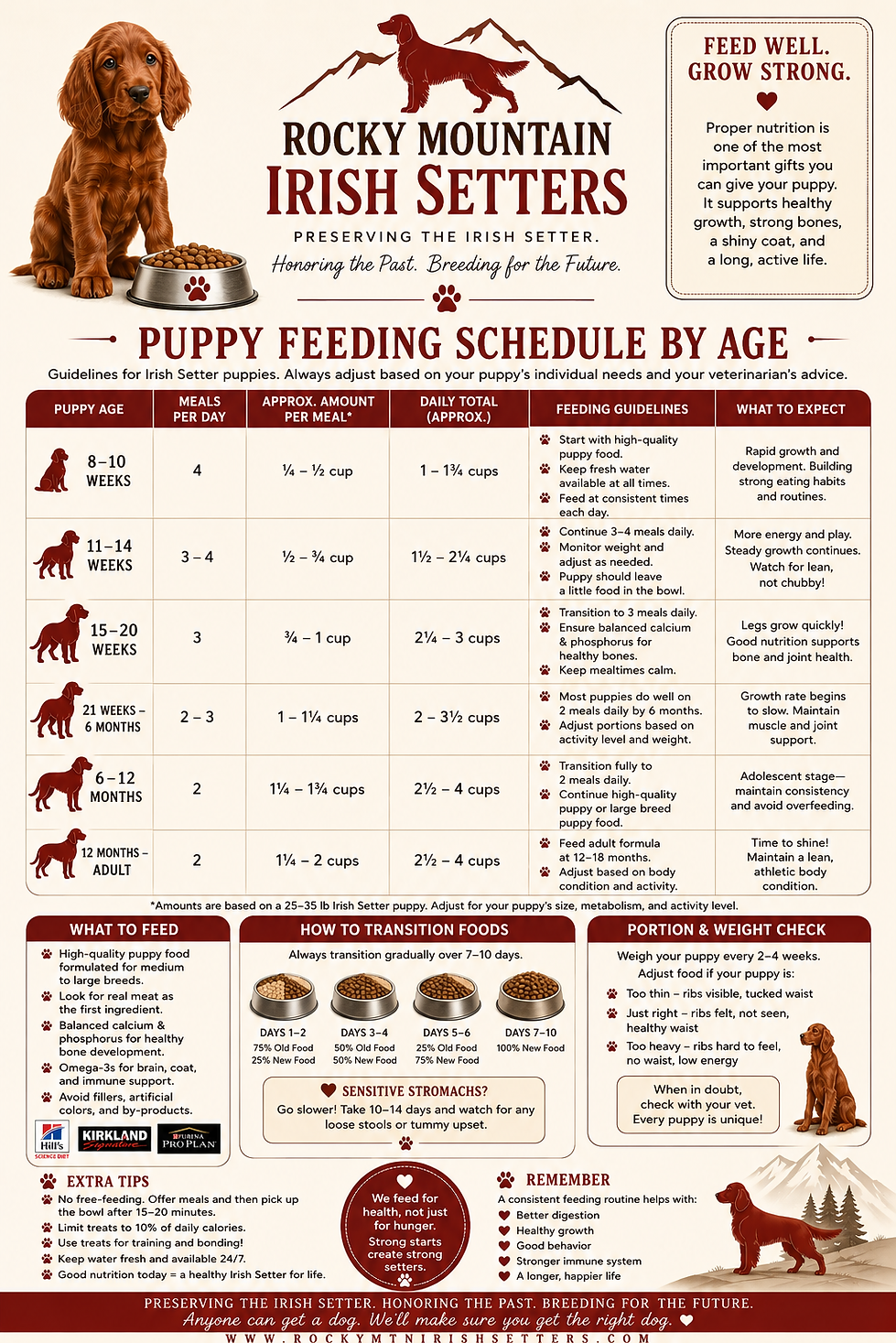
❤️ How often should I feed my Irish Setter puppy?
Irish Setter puppies grow quickly and need consistent, balanced nutrition to support their developing bones, muscles, and joints.
We recommend establishing a regular feeding schedule rather than leaving food out all day.
General Feeding Guidelines:
-
8–12 Weeks: Three to four meals daily
-
3–6 Months: Three meals daily
-
6 Months and Older: Generally two meals daily
-
Adults: Two measured meals daily
These are general guidelines. Your veterinarian can help determine the best schedule and daily food portions for your growing puppy.
Because Irish Setters are large, active dogs, it's important to feed an age-appropriate, complete and balanced diet formulated to support healthy growth in large-breed puppies.
Avoid overfeeding or encouraging excessively rapid growth, which can place unnecessary stress on developing joints.
Our Recommendation: Feed measured portions at consistent times, monitor your puppy's body condition, and avoid vigorous exercise immediately around mealtimes. Fresh drinking water should always be accessible.
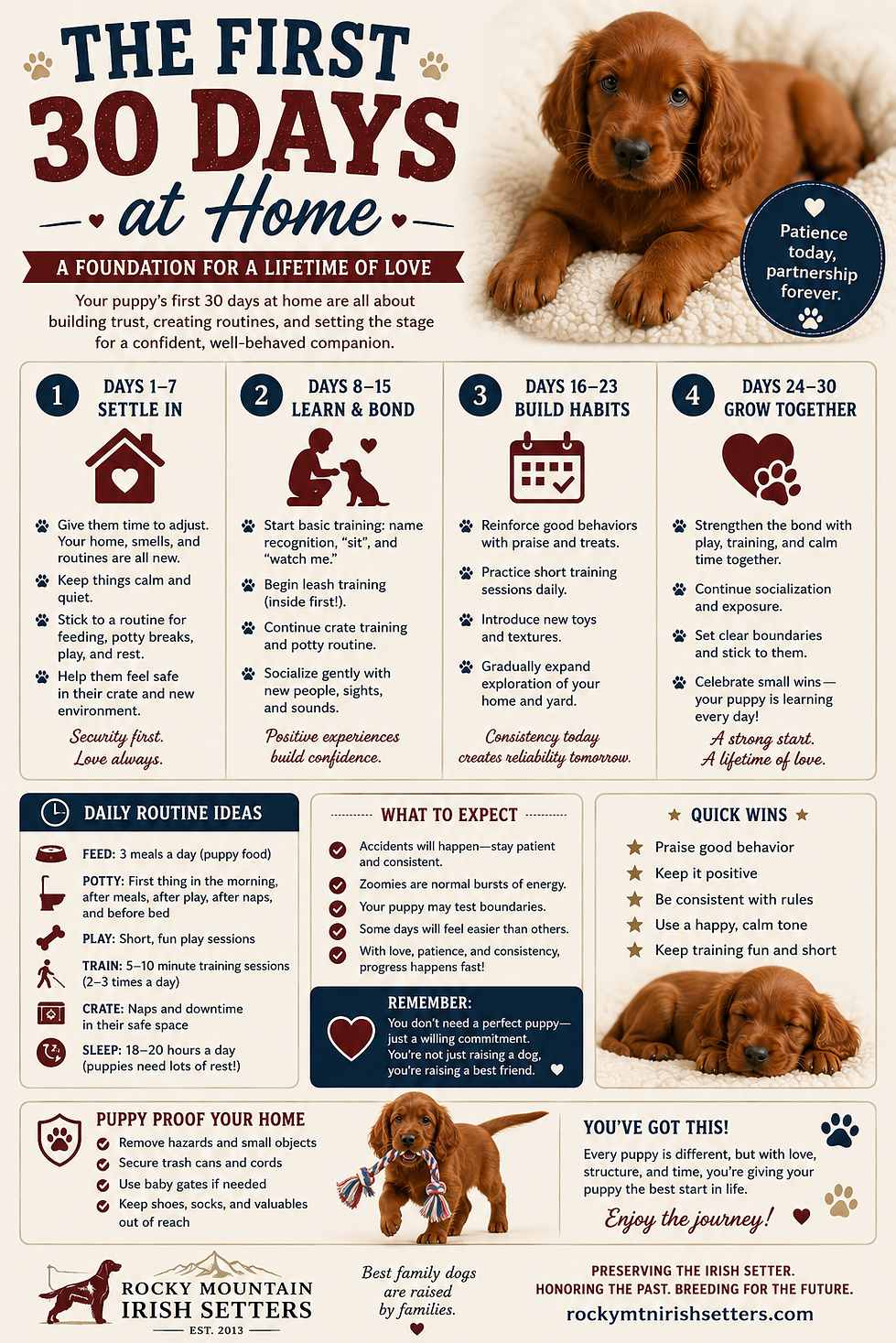
❤️ What is crate training, and why is it important?
Crate training teaches your puppy to feel comfortable, relaxed, and secure in their own personal space.
Think of a crate as your puppy's very own bedroom—a safe, cozy retreat where they can rest and recharge.
Irish Setters are incredibly social dogs that love spending time with their people. While we adore this affectionate quality, it's equally important that they learn how to relax independently.
Benefits of Crate Training:
-
Helps establish healthy sleeping routines
-
Supports potty training
-
Provides a safe place when direct supervision isn't possible
-
Helps prevent destructive chewing and household accidents
-
Makes travel, boarding, and veterinary stays easier
Our Favorite Crate Training Tips:
-
Introduce the crate gradually and make it a positive experience.
-
Offer special treats, safe chew toys, or meals inside the crate.
-
Begin with short periods and slowly increase the duration.
-
Never use the crate as punishment.
-
Always provide appropriate potty breaks, exercise, affection, and companionship.
Our Recommendation: Start crate training early, be consistent, and remember that patience is everything! The goal is to teach your puppy that their crate is a comfortable place to relax—not somewhere they feel isolated or frightened.
❤️ How do I potty train my Irish Setter puppy?
Potty training requires consistency, patience, and a predictable routine.
The good news? Irish Setters are intelligent and eager to learn, especially when training is
positive and rewarding!
Take your puppy outside:
-
Immediately after waking up
-
After meals and drinking
-
After playing or exercising
-
Before bedtime
-
Frequently throughout the day
Young puppies have small bladders and limited bladder control, so accidents are a normal part of learning.
Choose a consistent potty location and immediately reward your puppy with praise or a small treat when they go outside.
If an accident happens, simply clean it thoroughly with an enzymatic cleaner. Never punish your puppy for having an accident.
Our Recommendation: Consistency is the secret to successful potty training! Establish a routine, supervise closely, and celebrate your puppy's successes.
❤️ Which bark collar do you recommend?
Irish Setters are expressive, intelligent, and social dogs. Barking is one of the ways they communicate excitement, frustration, fear, or a desire for attention.
Before considering a bark collar, it's important to understand why your dog is barking.
Common causes include boredom, excitement, separation-related distress, alerting to unfamiliar sounds, and unmet physical or mental needs.
We recommend starting with positive, reward-based training rather than shock, spray, or other punishment-based bark collars, which can increase stress or anxiety in some dogs.
Helpful alternatives include:
-
Teaching a reliable "quiet" cue using positive reinforcement
-
Providing appropriate daily exercise and enrichment
-
Rewarding calm behavior
-
Managing environmental triggers
-
Addressing separation-related distress with a qualified professional
Our Recommendation: Focus on understanding the behavior rather than simply suppressing the barking. If excessive barking continues, consult a certified reward-based trainer or veterinary behavior professional.
❤️ Do you recommend an Apple AirTag for my Irish Setter?
An Apple AirTag can be a helpful additional tool for keeping track of your dog's belongings or locating your dog in certain situations.
AirTags use Apple's Find My network to help locate items when compatible Apple devices are nearby.
However, an AirTag is not a GPS pet tracker and does not provide continuous, real-time location tracking.
For Irish Setters who enjoy hiking, exploring, or outdoor adventures, we recommend considering a dedicated GPS dog collar or tracker with reliable location monitoring and appropriate cellular or satellite coverage.
Our Recommendation: A microchip, secure identification tag, and properly fitted collar are essential. A GPS tracker can provide an additional layer of security for adventurous dogs. An AirTag may be useful as a backup, but it should never replace proper identification or a dedicated tracking system.
When is the best time to spay or neuter my dog?
Current research suggests waiting until approximately 18 months to 2.5 years of age before spaying or neutering large-breed dogs. Allowing your puppy to reach full physical maturity supports healthy growth plate development, proper hormonal maturation, joint health, and overall long-term wellness.
Important Notes
-
Shelter Puppies: If you adopted from a shelter, they may have spayed the puppy as early as 8 to 12 weeks old to ensure population control before adoption.
-
The "In Heat" Rule: Most vets recommend not spaying a dog while she is actively in heat, as the increased blood flow to the area makes the surgery riskier. It is typically safer to wait 2–3 months after the heat cycle ends.
-
Consult Your Vet: Always talk to your vet by the time your puppy is 4–6 months old to create a personalized plan based on her specific health and breed.
sible Breeding
The health and well-being of our dogs and puppies is a top priority. All of our breeding dogs are carefully selected and health tested to support long-term soundness, excellent temperament, and quality of life.
Our dogs are DNA tested for Irish Setter–specific PRA (Progressive Retinal Atrophy), an inherited eye condition that can cause vision loss later in life. Through genetic testing and thoughtful pairing, we ensure that our puppies are not at risk of developing PRA.
We also screen for orthopedic health using OFA hip and elbow evaluations and, in some cases, PennHIP testing, which measures hip joint laxity and helps predict the risk of future hip arthritis. These evaluations allow us to make informed breeding decisions that prioritize structural soundness and mobility.
When applicable, our dogs receive CAER eye examinations performed by board-certified veterinary ophthalmologists to confirm overall eye health.
By combining genetic testing, orthopedic screening, and professional evaluations, we are committed to responsible, transparent breeding practices that support healthy, well-rounded Irish Setters for families and the field.
How often to do you recommend feeding?
A $250 reservation deposit is required to reserve your place on our waitlist. This deposit is fully refundable at any time if your plans change. It simply allows us to thoughtfully plan puppy placements and prioritize families who are ready to welcome a puppy into their home.
What is Crate Training?
A $250 reservation deposit is required to reserve your place on our waitlist. This deposit is fully refundable at any time if your plans change. It simply allows us to thoughtfully plan puppy placements and prioritize families who are ready to welcome a puppy into their home.
Which bark collar do you recommend?
The remaining balance is due at the time your puppy is picked up or personally delivered to your family.
What Apple Air Tag do you recommend?
A $250 reservation deposit is required to reserve your place on our waitlist. This deposit is fully refundable at any time if your plans change. It simply allows us to thoughtfully plan puppy placements and prioritize families who are ready to welcome a puppy into their home.
How soon can I take my puppy to dog parks?
-
Puppies are not fully protected until 1–2 weeks after their final DHPP vaccine (around 16 weeks)
-
Avoid dog parks, pet stores, and unknown dogs until fully vaccinated
What is Parvo?
-
Puppies are not fully protected until 1–2 weeks after their final DHPP vaccine (around 16 weeks)
-
Avoid dog parks, pet stores, and unknown dogs until fully vaccinated
Do your dogs hunt?
-
Puppies are not fully protected until 1–2 weeks after their final DHPP vaccine (around 16 weeks)
-
Avoid dog parks, pet stores, and unknown dogs until fully vaccinated
❤️ Health Testing & Responsible Breeding
❤️ What health testing do your breeding dogs receive?
At Rocky Mountain Irish Setters, the health, temperament, and lifelong well-being of our dogs are at the heart of everything we do.
We believe responsible breeding begins long before a litter is born. That's why we carefully select our breeding dogs and invest in comprehensive health testing to make informed decisions that support future generations of Irish Setters.
Our health-screening program includes several important evaluations.
🧬 Genetic Testing — Embark DNA
Our breeding dogs undergo genetic screening through Embark, including testing for inherited conditions relevant to Irish Setters.
One important condition we screen for is Progressive Retinal Atrophy (PRA), an inherited retinal disease that can cause progressive vision loss and eventual blindness.
Through genetic testing and thoughtful breeding decisions, we work to prevent puppies from inheriting two copies of a disease-causing variant for the conditions we screen.
DNA screening is an important tool, but it cannot identify every inherited disease or guarantee that a puppy will never develop a medical condition.
🦴 OFA — Orthopedic Foundation for Animals
OFA evaluations help us assess important aspects of our breeding dogs' health.
Hips and Elbows: Radiographic evaluations assess joint structure and signs of developmental orthopedic disease.
Thyroid: Laboratory evaluations help screen for autoimmune thyroiditis and thyroid-related health concerns.
Eyes: Eye examinations can identify certain inherited or acquired eye abnormalities.
🦴 PennHIP — Hip Joint Evaluation
PennHIP is another valuable orthopedic screening tool that measures hip joint laxity, or how loosely the femoral head fits within the hip socket.
A dog's PennHIP Distraction Index (DI) helps estimate their relative risk of developing hip osteoarthritis.
OFA and PennHIP provide complementary information:
-
OFA: Evaluates hip conformation and radiographic evidence of joint disease.
-
PennHIP: Measures passive hip laxity, which helps predict future osteoarthritis risk.
Together, these tools help us make more informed breeding decisions.
👁️ CAER — Companion Animal Eye Registry
CAER examinations are performed by veterinary ophthalmologists to screen for certain eye abnormalities and inherited eye conditions.
These examinations complement DNA testing because not all eye diseases can be identified through genetic screening alone.
🏅 CHIC — Canine Health Information Center
The Canine Health Information Center (CHIC) is a program administered through OFA in cooperation with national breed clubs.
A CHIC number indicates that a dog has completed the breed-specific health screenings required for participation and that the results are publicly accessible.
Important: A CHIC number does not mean every test result was normal. It demonstrates that the required testing has been completed and disclosed.
❤️ Our Commitment to Responsible Breeding
No breeder can promise that a dog will never experience a health problem. However, thoughtful breeding practices, genetic testing, orthopedic evaluations, and veterinary screening allow us to make informed decisions that reduce known risks.
Our goal is to preserve the beauty, temperament, and distinctive qualities of the Irish Setter while prioritizing long-term health and quality of life.
Preserving the Irish Setter. Honoring the Past. Breeding for the Future.
❤️ Are your puppies AKC registered?
Our Irish Setters come from AKC-registered bloodlines, and are provided with AKC registration paperwork.
We are happy to explain the differences and answer any questions about pedigrees, registration, and breeding rights.
❤️ Are your puppies microchipped?
Yes! Our puppies are microchipped before going home.
A microchip is a small identification device implanted beneath the skin. When scanned by a veterinarian, animal shelter, or other authorized organization, it provides a unique identification number that can be linked to the owner's contact information through a registration database.
A microchip is not a GPS tracking device, but it provides valuable permanent identification if your dog is ever lost.
Our Recommendation: Register your puppy's microchip promptly and keep your contact information updated throughout your dog's life.
❤️ Do your Irish Setters hunt?
Irish Setters were originally developed as sporting dogs, bred for their keen sense of smell, athleticism, and natural bird-hunting instincts.
At Rocky Mountain Irish Setters, we focus on bench (show-line) Irish Setters, rather than field-bred working lines. That being said, we've had multiple pups go on to become trained hunting dogs!
Our breeding program prioritizes the beautiful conformation, affectionate temperament, intelligence, and family-friendly personalities traditionally associated with show-line Irish Setters.
While many of our dogs retain natural sporting instincts and may enjoy activities such as scent work, hiking, retrieving, and exploring, they are not specifically bred or trained as competitive hunting dogs.
Our Philosophy: We love Irish Setters for their incredible companionship, adventurous spirit, and devotion to their families.
Whether your Irish Setter is joining you on a mountain trail or curling up beside you on the couch, our goal is to raise dogs that make exceptional lifelong companions.
Family Dogs Raised by Families. ❤️






Let’s Work Together
Get in touch so we can start working together.


